BIS Certification in India: Complete Guide to Process, Documents, Benefits & Requirements (2026)
BIS Certification is an important quality and safety compliance requirement for various products manufactured, imported, and sold in India. The Bureau of Indian Standards (BIS) is India's national standards body, responsible for developing Indian Standards and ensuring product quality, safety, and reliability.
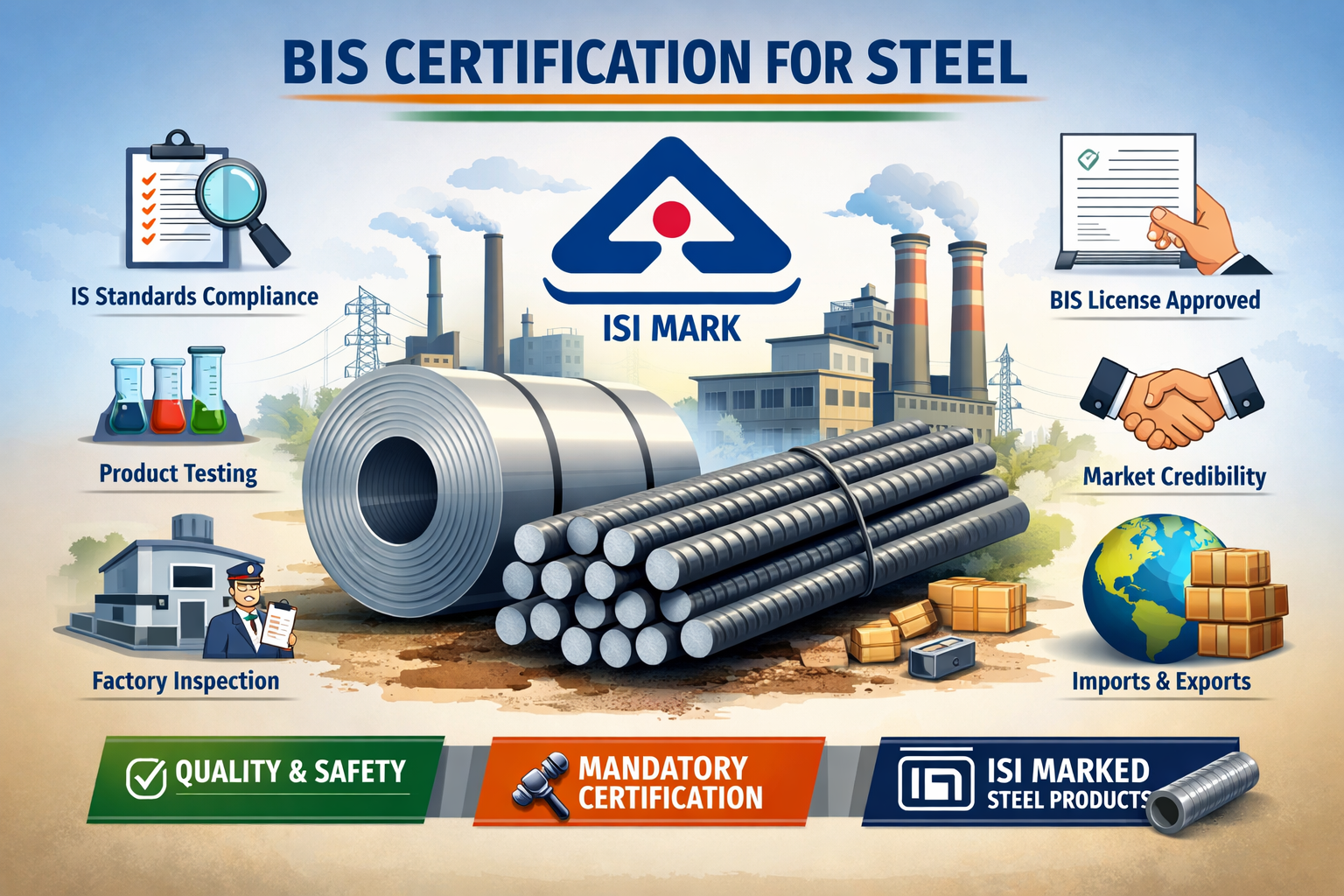
BIS certification helps manufacturers and importers demonstrate that their products comply with applicable Indian Standards. Depending on the product category, certification may be voluntary or mandatory under government-issued Quality Control Orders (QCOs).
What Is BIS Certification?
BIS Certification is a conformity assessment system operated by the Bureau of Indian Standards under the BIS Act, 2016. It allows eligible manufacturers to use the applicable BIS Standard Mark on products that meet the requirements of relevant Indian Standards.
The certification process generally involves product testing, verification of manufacturing facilities, assessment of quality control procedures, and examination of relevant documents.
Why Is BIS Certification Important?
BIS certification offers several advantages to manufacturers, importers, and consumers.
- Product Quality: Helps ensure conformity with applicable Indian Standards.
- Consumer Confidence: Improves trust in the quality and safety of products.
- Legal Compliance: Helps businesses comply with mandatory government regulations.
- Brand Reputation: Enhances business credibility and market recognition.
- Market Access: Supports the sale of regulated products in India.
Types of BIS Certification in India
1. ISI Mark Certification – Scheme I
ISI Mark Certification is one of the most recognized BIS certification schemes in India. Under Scheme I, manufacturers obtain a BIS license to use the ISI Mark on products conforming to the relevant Indian Standard.
The process generally includes:
- Application submission
- Factory inspection
- Product sample testing
- Verification of manufacturing facilities
- Assessment of quality control systems
- Grant of BIS license after successful evaluation
2. BIS Registration – Scheme II (CRS)
The Compulsory Registration Scheme (CRS) primarily covers notified electronic and IT products. Under this scheme, manufacturers must register applicable products with BIS after ensuring conformity with the relevant Indian Standards.
Common product categories include:
- Mobile phones
- LED lighting products
- Power banks
- Laptops
- Electronic accessories
- Other notified electronic and IT products
3. Foreign Manufacturers Certification Scheme (FMCS)
The Foreign Manufacturers Certification Scheme is designed for manufacturers located outside India who want to sell products covered under applicable BIS certification requirements in the Indian market.
The process may include:
- Application submission
- Appointment of an Authorized Indian Representative
- Factory inspection
- Product testing
- Documentation verification
- Grant of BIS license
4. BIS Scheme X Certification
Scheme X is another BIS conformity assessment scheme applicable to notified products and categories under its regulatory framework. It covers specified machinery, electrical equipment, and related products as prescribed by applicable government notifications.
BIS Certification Process in India
The general steps involved in obtaining BIS certification are explained below.
Step 1: Identify the Applicable Indian Standard
Identify the Indian Standard (IS) applicable to your product. Product testing and certification requirements depend on the relevant standard.
Step 2: Check Mandatory Certification Requirements
Check whether your product is covered under a Quality Control Order (QCO) or another applicable compulsory certification notification.
Step 3: Prepare Required Documents
Prepare the necessary business, manufacturing, product, and technical documents according to the applicable BIS certification scheme.
Step 4: Product Testing
Submit product samples to the appropriate BIS-recognized laboratory wherever required. The laboratory evaluates the product against the applicable Indian Standard.
Step 5: Factory Inspection
For schemes requiring factory assessment, BIS officials inspect the manufacturing facility and examine quality control procedures, testing arrangements, and production capabilities.
Step 6: Application Review
BIS evaluates the application, laboratory test reports, factory assessment, and supporting documents.
Step 7: Grant of BIS Certification
After successful completion of the applicable requirements, BIS grants the relevant license or registration.
Documents Required for BIS Certification
Commonly required documents include:
- Company registration certificate
- GST registration certificate, where applicable
- Manufacturing unit address proof
- Factory layout and manufacturing details
- Product specifications and technical details
- Machinery list
- Testing equipment details
- Quality control documents
- Product test reports, where applicable
- Trademark authorization, where applicable
- Authorized signatory details
- Authorization documents for foreign manufacturers, where applicable
BIS Certification Cost in India
The cost of BIS certification depends on several factors, including product category, applicable Indian Standard, certification scheme, number of product models, laboratory testing charges, factory inspection requirements, and applicable BIS fees.
There is no single fixed price for every BIS certification. Manufacturers should check the latest official BIS fee schedule and obtain a product-specific cost estimate before starting the application process.
How Long Does It Take to Get BIS Certification?
The certification timeline varies depending on the applicable scheme, product category, laboratory testing requirements, factory inspection, and completeness of the application.
Applicants should confirm the expected processing timeline for their specific product and certification scheme.
Is BIS Certification Mandatory in India?
BIS certification is generally voluntary. However, the Government of India has made certification mandatory for certain products through Quality Control Orders and other applicable regulatory notifications.
Manufacturers and importers dealing in notified products must comply with the relevant requirements before manufacturing, importing, distributing, or selling those products in India, subject to applicable exemptions.
Common Challenges in Obtaining BIS Certification
- Selecting the wrong Indian Standard
- Incomplete application documentation
- Failure to meet product testing requirements
- Inadequate manufacturing infrastructure
- Delays in laboratory testing
- Lack of knowledge about applicable QCOs
- Incorrect product classification
Why Choose a BIS Certification Consultant?
Obtaining BIS certification can involve technical documentation, product testing, factory assessments, and regulatory compliance. A professional BIS certification consultant can help businesses understand the applicable requirements and coordinate the certification process.
Consultancy support may include:
- Identifying applicable Indian Standards
- Checking mandatory certification requirements
- Preparing application documentation
- Coordinating product testing
- Assisting with factory inspection preparation
- Supporting application-related communication
- Providing regulatory compliance guidance
Frequently Asked Questions About BIS Certification
1. What is BIS certification?
BIS certification is a conformity assessment system that verifies whether products comply with applicable Indian Standards.
2. Is BIS certification mandatory for all products?
No. BIS certification is generally voluntary, but it is mandatory for products covered under applicable government notifications and Quality Control Orders.
3. Who can apply for BIS certification?
Eligible domestic and foreign manufacturers can apply under the relevant BIS certification schemes, subject to scheme-specific requirements.
4. What is the difference between ISI Mark and BIS Registration?
ISI Mark certification generally operates under Scheme I, while BIS Compulsory Registration Scheme (CRS) operates under Scheme II. Both have different procedures and product coverage.
5. Can foreign manufacturers obtain BIS certification?
Yes. Foreign manufacturers can apply through applicable schemes, including FMCS or CRS, depending on the product category.
6. How much does BIS certification cost?
The cost varies according to the product, certification scheme, testing requirements, and applicable BIS fees.
7. How can I check whether my product requires BIS certification?
You can check the official BIS website and review the applicable product list, Indian Standard, and Quality Control Order.
8. Can I sell products without BIS certification?
If a product is covered under a mandatory BIS certification requirement, it generally cannot be sold or imported without the applicable approval after the relevant QCO comes into force, subject to notified exemptions.
Conclusion
BIS Certification is an important part of product quality assurance and regulatory compliance in India. It helps manufacturers and importers demonstrate product conformity, improve consumer confidence, and meet applicable government requirements.
Understanding the correct certification scheme, identifying the relevant Indian Standard, preparing accurate documentation, and completing product testing are essential steps in the process.
Need Assistance with BIS Certification?
Are you a manufacturer, importer, or business owner looking for BIS certification in India? Get professional guidance for ISI Mark certification, CRS registration, FMCS certification, Scheme X certification, and other product compliance requirements.
Contact our team today to understand the applicable BIS certification process for your product.
For more information, visit the Official BIS Website.
 Driving 40% Growth for a Retail GroupRetail & E-commerce · Fieldcraft Retail Group
 Digital Transformation for a Regional BankFinancial Services · Meridian Bank
 Rebuilding a Global Supply ChainManufacturing · Kinetiq Industries
 Improving Hospital OperationsHealthcare · Solace Health
 Scaling a SaaS Company to New MarketsTechnology · Stackwise
 Post-Merger Integration Done RightFinancial Services · Aurelia Capital
 Repositioning a Property PortfolioReal Estate · Halcyon Properties
 Five-Year Growth StrategyTechnology · Quantix
 How to Build a Future-Ready Business StrategyStrategy · Mar 18, 2026
 Leadership in Times of ChangeLeadership · Mar 9, 2026
 Strategic Planning That Actually Gets ExecutedStrategy · Feb 27, 2026
 Making Better Decisions With DataDigital · Feb 16, 2026
 Five Levers for Sustainable GrowthFinance · Feb 5, 2026
 Designing a Productive Hybrid OrganizationOperations · Jan 24, 2026
 Robert HayesManaging Partner
 Laura BennettPartner, Strategy
 William GrantSenior Advisor, Finance
 Natalie RossPartner, Operations
 Sophia TurnerDirector, People